
SPS Coral Care
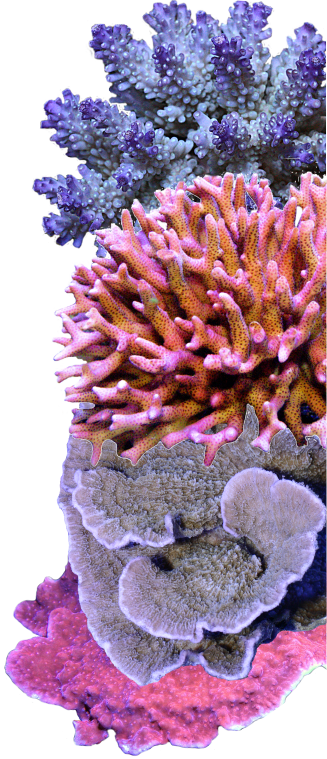
SPS coral care
SPS (Small Polyp Stony) is a hobbyist term used to loosely identify a group of corals that are at least somewhat similar in appearance and care. These corals always have hard skeletons and very small polyps - usually not much bigger than a pin head though there is no set size requirement. To the new hobbyist SPS corals like Acropora, Montipora, Pocillopora, and Bird's Nest can be somewhat intimidating. These stony corals come in an incredible variety of colors and growth forms that can be absolutely stunning. However, their care requirements are generally a step or two above the usual beginner corals like softies and LPS.
Moderate to intense lighting, good random flow, and clean, stable water quality are keys with these corals. Properly maintained they can grow quite quickly. Growth forms include branching, plating, and encrusting varieties. Fortunately, their stony skeletons are usually quite easy to frag, making them favorites for propagation and trading.
Special Notes
Some SPS corals, such as those that are plating or have especially thin branches, can be somewhat fragile and easily broken. Care should be taken when working in your tank to prevent accidental fragging. Generally, SPS corals do not need to be fed directly and specifically feeding your tank for the sake of SPS corals is usually not recommended as this can lead to excessive nutrient levels and poor coloration. Strategic use of amino acids may be beneficial, but we recommend you do some research as this is a more advanced topic. A great food for SPS corals are live bacteria such as several of the Hydrospace products. The particle size of the bacteria are perfect for the small polyps and broadcast, tank-wide, feeding is not a problem since the live bacteria do not add to the nutrient load in the tank. Instead, the bacteria actually help to lower excess waste in the water at the same time as feeding your corals. Any other food that is fed for SPS corals will add pollutants to the water. Live foods such as Rotifers are also a very good food for SPS corals since their size is small enough and since they are live they don't pollute the water.
Quick Tips:
SPS Corals
Care Level
Moderate to Advanced
Aggressiveness
Low to moderately aggressive toward other species of SPS. May be stung by more aggressive species such as LPS, especially those that produce sweeper tentacles.
Lighting Requirements
Moderate to intense lighting such as Metal Halide, T-5, or LED recommended. Some may be kept under weaker lighting but this may result in color shifting. Generally PAR levels of 250-400 are recommended.
Water Flow
Strong, random flow is generally preferred. Constant direct flow is not recommended.
Tank Placement
Mid tank or higher.
Water Quality
Very clean water helps to prevent browning out. Keep nitrates at 2-10ppm, and phosphates between 0.1 and 0.5. You can check these levels with Salifert test kits or via ICP testing.
Calcium, Alkalinity, and Magnesium levels are important for skeletal growth.
Specific Gravity: 1.025-1.028, check with calibrated refractometer or glass hydrometer. This higher range of salinity is closer to natural saltwater levels and helps keep elements higher than lower salinity.
Alkalinity 7-8 dKH, check with Salifert kit or Hanna colorimeter
Calcium 425-450, check with Salifert kit or Hanna colorimeter
Magnesium 1250-1350, check with Salifert kit or Hanna colorimeter
Iodine 60-90 ug/l, only accurate test is ICP
Monthly ICP testing is recommended for accurate Iodine level, including other trace elements and metals. Daily alkalinity testing is best, weekly calcium and magnesium testing is adequate. Stable alkalinity is the number one priority! Correct Iodine and other trace elements such as Strontium, Molybdenum, and others are critical for long-term success and excellent coloration of SPS corals.
Dosing should ONLY BE DONE in conjunction with accurate testing. Avoid blind dosing or dosing so-called coral foods or other "miracles" in a bottle.
Acorpora
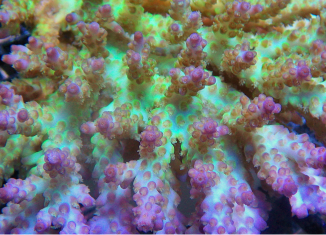
When new hobbyists start thinking about stony corals, often Acropora are what come to mind. In the wild they are often found to be the dominate coral on Pacific reefs and are quite common. While they might technically be grouped with other SPS type corals, their care is slightly more demanding, so they are often discussed separately.
Corals of this genus are without a doubt some of the most vibrantly colorful corals available for reef tanks today. They can be found in reds, blues, greens, purples, pinks, yellows, and many more, not to mention the variety of contrasting colors between established branches, growing tips, and even polyps. Acropora also come in a variety of growth forms such as table, bottlebrush, staghorn, branching, bushy, and more. These two traits of color and form give rise to an incredibly diverse group of corals at least in appearance. Fortunately, care requirements are similar for most members of the Genus. Almost all corals of the group are very easy to frag by removing a single branch and are fairly fast growing under ideal conditions, making them favorites for captive propagation and trading.
Special Notes
Acropora do have something of a reputation for being tricky to keep. They are sensitive to water quality problems, as well as to lighting. Frags and small colonies (especially captive grown) tend to ship better and have a better track record for home survival. However, for the experienced hobbyist who is prepared to meet their needs these can be some of the most rewarding and beautiful corals to keep.
Acropora demand a care level for the more advanced reef aquarist. They are moderately aggressive towards other SPS type corals. May be stung by more aggressive corals like the LPS, especially those that produce sweeper tentacles.
Strong light like Metal Halides, T-5's, or LED recommended and water flow should be strong and random flow is preferred. Place Acropora coral on the top third of tank and make sure your water is very clean. Stable water quality is preferred and may help prevent browning out and your Calcium, Alkalinity, and Magnesium levels are important to skeletal growth.
Montipora
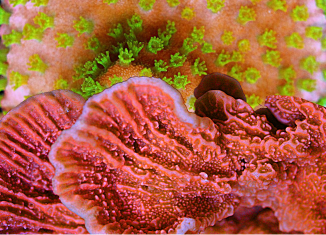
Montipora are some of the most popular SPS corals out there, especially for those new to SPS keeping. They are often easier to keep and hardier than Acropora and come in a fascinating array of growth forms and colors. Included in the group you’ll find everything from heavy encrusting specimens to the finger like branching Montipora digitata and the delicate plating Montipora capricornis. Bright body colors are often contrasted by equally brilliantly colored polyps, and often show even greater variation between new growth and older more established sections. Fast growing and easily fragged, these are fantastic corals for propagation and captive culture as well.
Special Notes
Take care working in tanks with plating or branchy specimens. New growth can sometimes be brittle, and these corals are very easy to accidentally frag!
Montipora require a moderate care level and have a low aggressive nature. Most Montipora are easily damaged by more aggressive neighbors and are unlikely to sting others.
Moderate to higher lighting is best but watch for color shifts and adjust light levels as needed for maximum color. They like a moderate to high water flow and placement should be in the upper half of the tank. Poor water quality with cause browning out and watch your calcium and magnesium levels which are important for skeletal growth.
Others
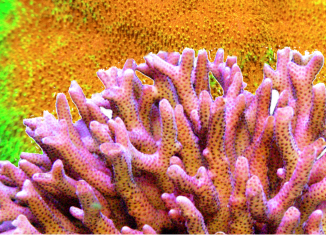
Other SPS corals include Pocillopora, Stylophora, and many others. All of these are generally easier to keep than Acropora and provide more diversity in shape and color.